


ABOUT
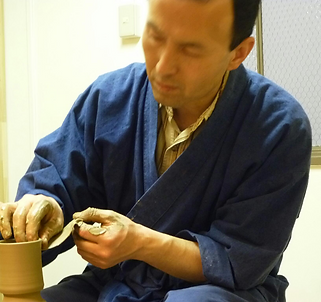

In 1585, Toyotomi Hidenaga, the younger brother of Toyotomi Hideyoshi, established the kiln at Akahadayama in Gojo Village, in what is now Yamato-Koriyama, Nara Prefecture.
This kiln is counted as one of the "Seven Enshu Kilns" favored by the renowned cultural figure, Kobori Masakazu (Kobori Enshu): 1579-1674.
As its name suggests, Akahada ware has a reddish tint to its surface. There are two theories as to the origin of its name: one is that it comes from the reddish color of the surface, and the other is that it comes from the local place name "Akahada-yama" (Akahada Mountain).
These reddish vessels are best known for being coated with a milky white Hagi glaze and decorated with a style of painting known as Nara-e.
Nara-e paintings are popular, down-to-earth styles often based on fairy tales and other folk themes. Their subtle and somewhat naive compositions skillfully bring out the rustic beauty of the pottery's surface.
Many of these designs feature figures or houses within two lines, and they also incorporate various motifs such as landscapes of Nara, deer, and scenes from old stories.
In the late Edo period, the lord of the domain, Yanagisawa Yasumitsu, provided patronage, and at the end of the Edo period, the master craftsman Okuda Mokuhaku showcased and popularized techniques such as imitating Ninsei's style.
This technique has been passed down through generations of artisans and continues to this day as an important cultural tradition representing Japan.
Oshio Masashi Pottery Studio
At our shop, we use rare clay from Mt. Akahada in Nara, and each item is meticulously crafted by hand, from collection to refinement.
The defining characteristic of Akahada ware is undoubtedly the beautiful reddish hue that develops on the surface of the pottery when the clay is fired in its original state.
In particular, the way a soft reddish hue gently appears at the boundary between the milky white glaze and the unglazed surface is a unique characteristic of Akahada ware.
Furthermore, the elegant Nara-style paintings are popular as a unique style characteristic of kilns in Yamato.
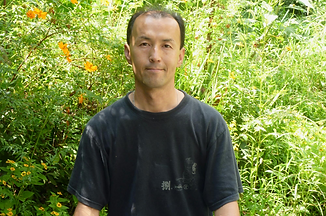
Masashi Oshio
Third son of Akahada ware potter Masayoshi “No. 8th Masato”
1990
Nara Junior College of Arts
Graduated from the Ceramics Department (Specialization Course)

